Research & Activities
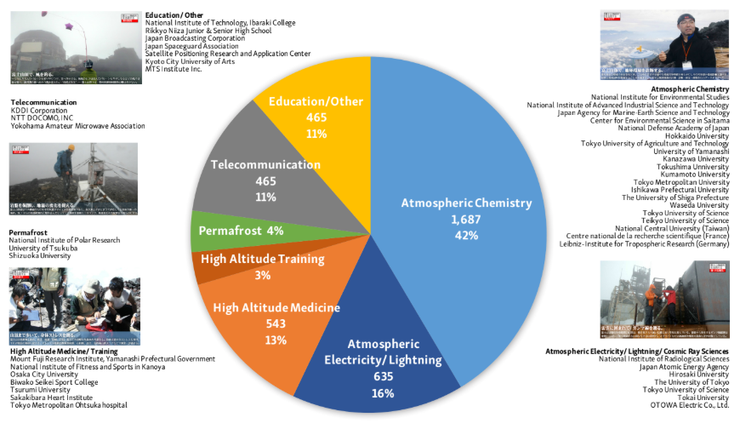
Standing at 3,776 meters, the summit of Mount Fuji is more than just Japan’s highest peak—it is a world-class natural laboratory. Situated within the free troposphere and subjected to extreme environmental conditions, the Mount Fuji Research Station (MFRS) offers a unique vantage point that cannot be replicated at sea level. This high-altitude outpost serves as a critical frontier for a diverse range of scientific disciplines, providing researchers with invaluable data that bridges the gap between Earth and space.
From monitoring transboundary air pollution and investigating the mysteries of lightning and cosmic radiation to advancing high-altitude medicine and testing next-generation satellite technologies, the research conducted here has far-reaching implications for both global environmental preservation and human safety. By collaborating with leading domestic and international institutions, we continue to push the boundaries of science, leveraging the mountain's "extreme" environment to solve the complex challenges of the 21st century.
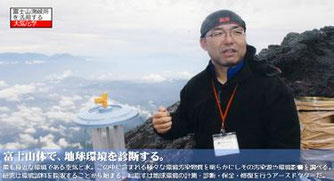
Atmospheric Chemistry
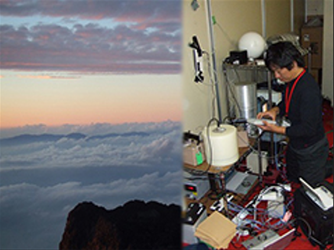
Mount Fuji is an isolated, high-altitude peak situated within the free troposphere. Because it remains relatively unaffected by local pollution, it serves as an ideal site for observing the long-range transport of pollutants, such as PM2.5 (fine particulate matter), originating from the Eurasian continent.
To date, observations of soot from Siberian forest fires and Kosa (Asian dust) from mainland China have demonstrated the mountain's potential as a "sensor" for global atmospheric circulation. Given the importance of studying substances like aerosols and greenhouse gases, direct field observations at this site are crucial.
Atmospheric chemistry research is currently conducted by a diverse group of scientists from JAMSTEC, NIES, and Japanese universities, as well as international partners from Taiwan, France, and Germany. Japan, located downwind of the rapidly developing Asian continent, is directly impacted by transboundary pollution that can eventually spread across the Pacific to the rest of the world. Efforts are also underway to strengthen monitoring networks by collaborating and sharing data with other high-altitude stations, such as Mauna Loa in Hawaii and Jungfraujoch in the Swiss Alps.
Atmospheric Electricity, Lightning, and Radiation
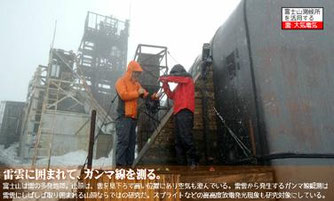
The summit of Mount Fuji is an ideal location for lightning research, as it is frequently approached—and often enveloped—by active thunderclouds. To fully understand these phenomena, research must focus not only on radiation but also on the electric fields generated by the clouds. Researchers have installed radiation detectors and electric field mills to investigate radiation behavior and electric field structures during the passage of thunderclouds. Furthermore, the scope of research is expanding into the upper atmosphere by combining observations of high-altitude discharge phenomena with airglow measurements directed toward the ionosphere. A notable achievement occurred in August 2014, when the team twice captured images of "Gigantic Jets," a phenomenon that is notoriously difficult to photograph anywhere in the world.
Radiation Science and Cosmic Radiation
Radiation exposure is not limited to nuclear incidents; we are constantly exposed to ionizing radiation from space. Aircraft crew members flying at altitudes of 10,000 meters or higher are exposed to cosmic rays—high-energy particles originating from outer space—at levels approximately 100 times greater than those at sea level. The Mount Fuji Research Station, situated at a high altitude with a thin atmosphere, provides an ideal vantage point for monitoring solar activity and galactic cosmic radiation. Continuous observation of cosmic-ray neutrons has already been demonstrated during summer research campaigns.
To ensure rapid and accurate assessments of radiation exposure for air travelers during sudden fluctuations in cosmic ray intensity caused by solar flares, a real-time monitoring system is being developed at the station. This system aims to estimate atmospheric doses in real time based on continuous high-altitude measurements. Looking ahead, the goal is to establish a permanent observation base at the summit to facilitate year-round monitoring of cosmic radiation exposure for the Japanese population.
Permafrost and Ecology
Due to its high altitude, the summit of Mount Fuji maintains an average annual temperature of approximately -6°C, making it the only location on Honshu where extensive permafrost can persist. In the summer of 2010, a research group led by Professor Ikeda from the Shinshu University Institute of Mountain Science successfully drilled a 10-meter-deep borehole for ground temperature observation near the summit. With temperature sensors installed inside the borehole, continuous monitoring of subsurface temperatures was established.
By directly observing ground temperature profiles at depth alongside meteorological data, researchers aim to clarify the primary factors influencing thermal changes in the ground. This study is crucial for evaluating the dynamics and spatial distribution of permafrost. These efforts are supported by a collaborative network of institutions, including the National Institute of Polar Research, Shizuoka University, the University of Tsukuba, the University of Tokyo, and the State University of New York (SUNY).

High Altitude Mountain Medicine
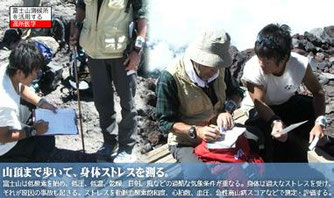
As Japan’s highest peak, Mount Fuji provides an ideal environment for elucidating the mechanisms of altitude sickness. At the summit, the oxygen concentration is only two-thirds of that at sea level. Common early symptoms of altitude sickness include headaches and nausea; however, if left untreated, the condition can progress to pulmonary edema and respiratory distress, which can be fatal. Under these hypoxic (low-oxygen) conditions, the pulmonary arteries constrict significantly. Investigating the heart’s response to such stress is crucial for understanding the mechanisms of heart failure and related cardiovascular conditions.
While climbing Mount Fuji has surged in popularity recently, many participants are first-time climbers. Despite being technically accessible, the ascent places a severe physical burden on the body, compounded by the physiological effects of high altitude. Every year, numerous accidents occur that are attributed to these combined stresses. To prevent such incidents, researchers are collecting objective data on the physical stress experienced during a climb. The ultimate goal is to publicize evidence-based safety measures to ensure a safer experience for all climbers.
Telecommunication technology
Standing as a natural "observation tower" approximately 3,776 meters high, Mount Fuji provides an ideal environment for telecommunications research. While various studies have been conducted here over the decades, recent efforts have focused on LPWA (Low Power Wide Area) technology, which enables ultra-low power consumption and stable, long-distance communication. Furthermore, ensuring mobile connectivity in the extreme conditions of the summit is a critical research area for climber safety.
Japan’s four major mobile carriers are actively conducting field experiments at the summit to test not only 4G but also 5G networks. These studies aim to determine the feasibility of providing stable, high-speed communication in such a challenging environment, ultimately enhancing both the experience and the safety of those reaching the peak.
Educational Material Development and Space Engineering
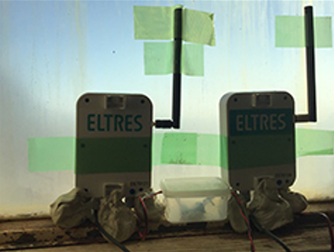
In collaboration with the University Space Engineering Consortium (UNISEC)—which supports "hands-on" education in space engineering through the development of microsatellites, CanSats (simulated satellites), and rockets—we are jointly developing an earthquake prediction satellite. This project involves creating a ground model and testing it under the extreme conditions of the Mount Fuji summit. The observation concepts and manufacturing techniques refined at this site will directly inform the design of the actual satellite.
In 2013, preliminary research was conducted to investigate the environmental similarities between the summit of Mount Fuji and outer space. During these overwintering observations, researchers used data loggers to monitor solar panel charging, battery status, and ambient temperature. Based on these findings, a simulated satellite, "Fuji-Sat," was installed at the summit in the summer of 2014 to further evaluate its performance in a space-like environment.